
This fall has me all up in my feels! It marks one year full-time in my business, four years sober, six years of motherhood, and another trip around the sun.
I can't think of a better way of celebrating than marking my busiest month yet, and spending this month with my Sober October group, taking control of their own wellbeing and busting out of autopilot.
I became a recovery coach after I got sober because I realized how many high achievers and leaders, like myself, were unhappy with their drinking or drug use or overwork, but weren't necessarily at a level of needing clinical care and were still crushing it at work. I knew when I went fulltime into my own business that I would integrate recovery coaching because I see the connection clearly. Leaders don't just need communication skills, emotional intelligence, and motivation skills to name a few, they need their own health and wellbeing. They need to keep their coping strategies in check and practice healthy stress management if they want to last and reach their potential.
In our group, we don't just give something up (alcohol, marijuana, nicotine, sugar, scrolling/screentime), we add the essentials in for 31 days straight: sleep, movement, hydration, connecting with community, and the one that gets everyone, 10 minutes of non-doing. As a society, we value doing, and many of us learned early that busyness was our ticket to acceptance, so we became the best doers ever! As a recovery coach, I've come to learn that overwork is actually one of the most socially acceptable addictions we have.
Ahhh the B word! (not that one. BUSY)
It shows up in our organizations, and it's a big reason so many people who find themselves in leadership roles have been left to just sink or swim. Who actually has time to develop their leaders?
Who counts as a leader?
In this corner of the internet, a leader is anyone who influences another person's wellbeing, pay, schedule, workload, growth, discipline, or safety. And if you're new here, safety covers all 3 P's: physical, psychological, and psychosocial.
There are more people than titles and pay capture if you look at leadership that way. Most of them don't think of themselves as leaders...and that's a problem for them and for your staff.
Two things I keep seeing in my workshops and 1:1 coaching:
1. The most common reason people stay or go is because of leadership and culture. This is from my informal surveys, but national research backs this up too. One MIT Sloan Management Review study found that toxic culture was about 10x more powerful than pay in predicting who left a job. The relationship with a direct supervisor and the conditions people work in tend to outweigh pay, benefits, and schedule in almost every study I have read and every workshop I've given in Alaska and Washington.
2. Leaders underestimate their own influence. In my workshops, I ask people to raise their hand if they're in a position of leadership. Every time, people look around the room, and usually only the senior executives raise their hands. In 1:1 coaching, when I ask someone to describe themselves as a leader, I almost always hear a qualifier: "I don't know if I'm really a leader." Or, "I have the title, but I don't really have the say." It's really rich coming from people with titles that include Director, or Manager, or Executive... How in the world do they not know they are leaders that have a VERY big influence on people's lives?
Put these observational data points together and there's a pretty big gap!
The people who have the most influence over whether someone stays or goes are often unsure how much influence they have. Some still see themselves as the technician they were five years ago. Some carry the responsibility without the title or pay and might almost in spiteful denial of the responsibility. Some have the title and pay without the authority, so they don't own it because they have no teeth. Most have never been told, plainly, the weight of their impact...
I see this gap as a giant opportunity. A low hanging fruit!
The B word at work
I get it. People are too busy to intentionally define the culture they want. Too busy to rework a job description every time they hire. Too busy to build a training or mentorship path when they promote someone from within.
I've risen into leadership in every job I've ever had, and only once did anyone mentor me through a promotion. Every other time, it was sink or swim, baby!
The company that gave me top-notch, informal mentorship was not the one I would have expected. After a promotion, the founder sat me down, asked how I was settling in, and acknowledged it was a big job. He talked about the people, the clients, the communities we impact, and the money (in that order). Then he said, our people had to be on my mind with every decision I made.
"So how many people are you responsible for?"he asked.
"119," I said.
"Multiply that by four. They have families. In fact, we work in a tight-knit communities. Multiply it by six. They have friends and community members who'd be impacted if things go well, and especially if things go bad. From now on, you better make decisions like 1,000 people will suffer if you mess it up."
"Make decisions like 1,000 people will suffer if you mess it up."
I felt the weight of this in my bones. Some people might crumble under that kind of pressure, but I live for a little pressure. He wasn't reciting a mission statement, he really meant it, and I've operated in that mindset ever since. I understood my responsibility. I understood my impact for better or worse.
So is the answer a heartfelt speech, bordering on a warning not to eff it up? Maybe that's part of it. The bigger conversation is what organizations and leaders build around that "real talk"in preparations and supports.
Context is Part of the Job
Before we define what a good leader looks like, and how we develop one effectively, we need context. What YOU value in a leader may be different from what their team needs or their industry needs. A great leader in Silicon Valley tech might struggle in Alaska oil and gas. A leader who thrives in a big city school might flounder in a small rural one. A CEO in Texas might fail miserably in Hawaii.
I think about leadership & workforce needs(regarding preparations and supports) in concentric circles: the organization at the center, then the industry, the local community, the region, the state, and the country.
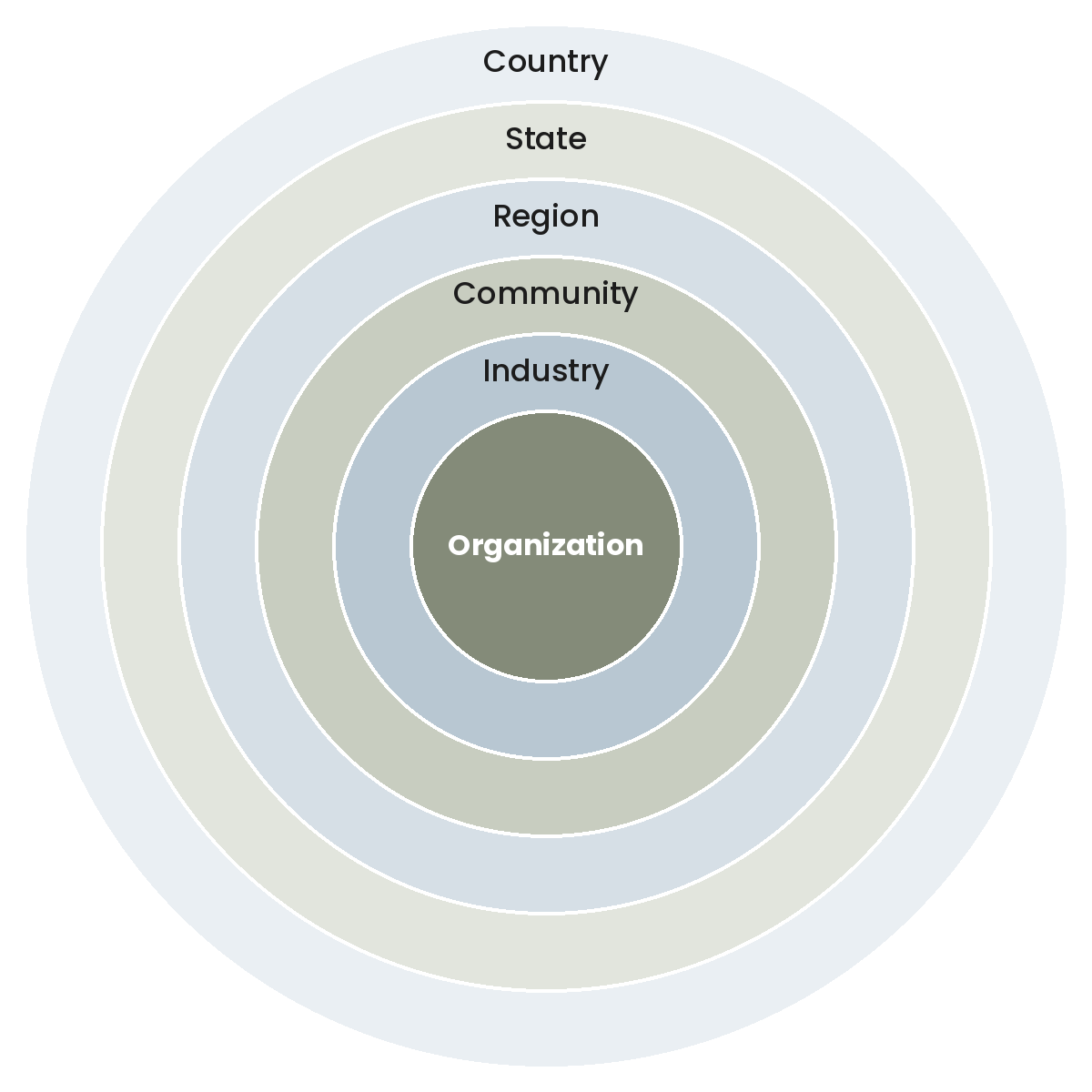
In Alaska, those outer circles carry extra weight and they aren't the ones we usually address in the workplace. Your state, your region, your community have their own vibe or culture, their own strengths, and their own vulnerabilities or underbellies. In Alaska, I call these the Alaska Factors: things like isolation, long dark and long light days, the cold, small, tight-knit places where everyone knows everyone, and our population health factors to name a few. These things shape how people experience work and life, how they cope, and how they need to be prepared or supported as a leader.
What Strong Organizations Do
The organizations I see growing and keeping great leaders tend to do three things well.
- They define the culture they intend, and they walk the walk. When mission, vision, and values are clear and lived, leaders have something to steer by. Without that, every leader runs on their own values and their own idea of good leadership, and those differ more than we think. A strong culture protects all 3 P's: physical, psychological, and psychosocial safety.
- They prepare leaders for the whole context, not just their inner circle. Whether they promote from within or hire from outside, they ask what knowledge, skills, and abilities will help this person thrive in this industry, this community, this region, and this state. Then they decide what to hire for, what to train, and where to pair someone with a mentor.
- They tell leaders the weight of their impact, and they back them up. Their leaders know they are the culture bearers. They collect feedback from the leader and from the team, and they support people who are leading inside complex systems.
What About You?
Leadership is as much of an inside job as it is a company's responsibility to cultivate. Leading yourself well is what makes it possible to lead others well. A few questions to sit with this week:
- Do you fully grasp the weight of your influence on the people around you?
- Who showed you the weight of leadership, and how did they do that?
- Do you know what your supervisor values most in your leadership? What about your team?
- Are you hanging by a thread and catching yourself reacting more than responding intentionally?
I would love to hear your answers from the above, or below. Just hit reply!
What is your organization doing well to recruit, grow, and keep strong leaders? What are you doing to make sure your influence lands well?
Events Where You Can Find Me & Coming soon
Where to find me in person
- Total Worker Health® course, University of Washington (starts October 8!)
- October 7-8 Alaska Workforce Convening & ASA Annual Meeting Breakfast
- October 12: Employment First Conference, Anchorage
- October 27: Rural Energy Conference, Fairbanks
If you'll be at any of these, reply and let me know. I'd love to say hi in person!
Coming Soon...Alaska Ready Leaders
I'm building a leadership development program for the realities of leading in Alaska: the industries, the communities, and the conditions that make this place unlike anywhere else. It's for supervisors, managers, and every "I don't know if I'm really a leader" leader.
I want it built with input from the people who'll use it. Hit reply if you're willing to answer some questions for me that might influence some of the content.
If you'd rather chat in person or virtually on any of this, schedule a meeting!
Naomi DuCharme | [email protected]
Workforce Wellbeing Advisor | Facilitor | Coach
Integrating Wellness Solutions: Where safety, health, wellbeing and retention aren't one-off programs or initiatives; they're outcomes of well-designed, integrated, systems.
© 2026 Integrating Wellness Solutions
Becoming Engines of Wellbeing™


Responses