If you're new here, I'm Naomi, a workplace safety, health & wellbeing strategist, a recovery & leadership coach, a mom, a nature lover, and a badass sober gal from Alaska. This newsletter is a place for me to share information and connect with you, inspire some new ways of thinking, and encourage positive change.
Let's talk about something that holds us back from change...asking for help. (WOOF) Why is it so hard?
For me, and many people I know, we spend so much time stuck or held back because of that four-letter word: H-E-L-P.
One word swap, offered by a colleague about why it's so hard to ask for help, completely changed how I think about this. I'll get to her word swap, but first:
The three steps in change that we don't give enough credit:
- Realizing there is an issue. Have to be aware and accept there is an issue.
- Deciding you are ready to make a change.
- Here's the sticky one: realizing you need help to make a plan and to do the damn thing.
Whether we are talking about personal change, or making change in your relationships, your home, or at work, lasting change rarely happens without these first three steps.
If you've never seen the stages of change model that is originally credited to Psychologists James O. Prochaska & Carlo C. DiClemente, here is the short version: change is not one singular event. Psychologically, we move through a process before we ever get to action. Here is a graphic I modified for this newsletter, originally credited to Prochaska & DiClemente:
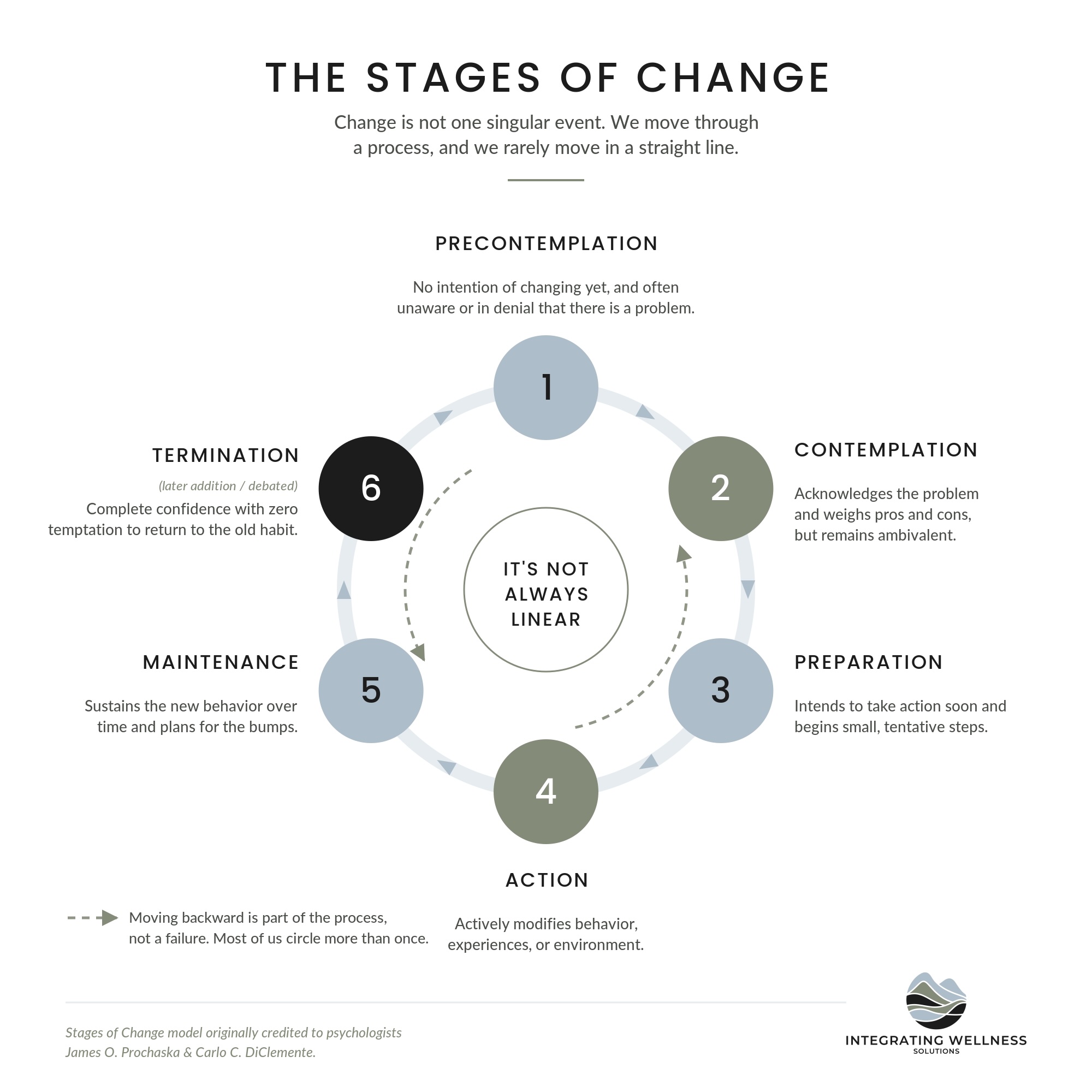
My work in coaching and in business has taught me that we spend a lot of time in precontemplation and contemplation, and that is not right or wrong, it's just something I've noticed. I'll also say, we don't always follow this model in a linear way. We sometimes bounce around throughout the change process, but nevertheless, to get to a place that you are actually aware there is a problem and you agree change is necessary is a whole journey.
We would all love to believe that once someone is aware there is an issue, then POOF, they will change themselves or change the thing that is causing issues. But that's not what usually happens. If it were as simple as just being aware of a problem for it to change, then we wouldn't have many.
Once we're aware, we then have to start weighing our options, then plan before we can take action, and this is where people get really stuck.
We either overanalyze and get paralysis by analysis, or we don't elicit other people's input and we can't seem to come up with the plan or take action on our own, or we have a great plan but have no idea HOW to start step one, so we stay stuck.
Ewww, asking for help
It can be really friggin hard for people to ask for help, for a whole slew of reasons:
- No one wants to appear incompetent.
- They may have had past experience with judgement or retaliation.
- Fear of getting diagnosed with something you don't want to have on your record.
- Fear your boss or your team will flip out when they find out there's a problem in the business you are supposed to be controlling.
- The big fear that lies under all of it: people seeing our flaws threatens our belonging, and our nervous system reads a threat to belonging a lot like it reads a threat to our safety. Researchers have found that social rejection activates some of the same brain regions as physical pain...no wonder we avoid it!
This is our reality. Humans are so complex AND we're prettysimple. We need water, food, shelter, belonging...there's other stuff too, but these are the biggies.
So, admitting there's a problem is hard, asking for help is hard, we all know this, but how do we push beyond that discomfort in order to make progress? Well, we can't push past it if it's not just discomfort, it's safety that we're pushing up against (physical and psychological). For this scenario, let's talk about when safety isn't the real consequence but we're still feeling stuck and uncomfortable:
The Reframe
I am the Community Director of an online sobriety group and I was facilitating a meeting on this very subject, and one of the wise women in the group offered this very powerful reframe, she said something along the lines of, "Ya know, it's so hard for us to ask for help as individuals, but in business, we say we need to outsource or subcontract, and there is no shame in that game. So why don't we just say we are outsourcing and stop saying we're asking for help?"
Friggin' Genius!
In business, when I am not the subject matter expert, or when I need to offload some work that I am totally capable of doing, but I want to use my time and energy on the work that I am uniquely positioned to do to make the greatest impact, I outsource and that is a power move! It gives me capacity, it allows for a higher quality outcome, and it gets me where I'm trying to go faster.
I have no problem outsourcing, but asking for help makes me physically squirm.
Call it outsourcing, call it delegating, call it bringing in a subject matter expert, call it asking for help. Pick the word that lets you actually move.
Words carry energy
I know we have all been taught, sticks and stones will break our bones but words will never hurt. But I beg to differ. Words matter and they can absolutely be the thing that shuts down our openness or willingness to move forward, or they can be what provides incredible clarity and inspiration. Words hold energy, whether it's the word itself or the tone, or the body language that goes with it. That's not "woo-woo", that's truth, and we can use that knowledge to find the words, the approach that actually "feels" right, or safe, or doable.
So, if asking for help has been the thing holding you or your team back, what would it feel like to "outsource" instead? What would it feel like to engage subject matter experts, or delegate to qualified support?
At the end of the day, it might all mean the same thing, but it feels different in our bodies and minds, and when it comes to human behavior, here's the thing we all need to be aware of: our emotional processing can run faster than our reasoning. When we feel threatened, the logical part of our brain can get quieter and the protective part gets louder. You can either fight that, or you can work with it and find your way forward!
Try this
If you want a place to start, name one thing on your list this week that you're fully capable of doing but your time would be better spent elsewhere or that you have been thinking about without taking action for far too long, and decide who you'd outsource it to. You don't have to actually reach out to the person or organization. Just name it. That's a preparation step, and gets you one step closer to action.
Wherever you are at with a change for yourself, or in your organization, I hope you are giving yourself and your team some grace to move through the process to be ready for action, while also holding yourself accountable to pushing discomfort for growth...without pushing safety.
You matter. Your impact matters and we don't need you stuck another year or waiting for things to get worse before you take action.
Upcoming Events
September 9th, 8:00am AK: Guest Speaker for the Alaska Business Education Compact (free and open to the public) Topic: The Retention Strategy Hiding in Plain Sight: Safety, Health & Wellbeing
Email for Link to Attend: [email protected]
Alaska’s workforce challenges won’t be solved by recruitment alone. We also need training environments and workplaces where people want stay, grow, contribute, and do their best work.
In this interactive session, Naomi DuCharme, Founder of Integrating Wellness Solutions, will reframe safety, health, and wellbeing as more than compliance or employee benefits; they are powerful, and underutilized workforce retention strategies. When people feel physically and psychologically safe, supported by healthy leadership, and able to work sustainably, they are better able to learn, engage, solve problems, innovate, and stay.
Together, we’ll explore how each of us can influence change, from leadership and work design inside our organizations, to industry culture, to the statewide systems shaping Alaska’s workforce.
This session isn't about OSHA Compliance, we're going explore this bigger question: What would it take to make Alaska #1 in the nation for workforce wellbeing, and what role can each of us play in getting there?
September: LeadWell: A 90-Day Capacity Reset for People Leaders (September 8-December 6) Email to inquire: [email protected]
September: LiveWell: A 90-Day Alcohol-Free Challenge (September 8-December 6) Email to inquire: [email protected]
October: Total Worker Health - Advancing Wellbeing in the Workplace through UW. I have been guest-lecturing for this course for two years, and Dr. Katia Costa-Black does an incredible job of keeping this course relevant for leaders working in industry now. If you are in HR, Safety, Workplace Wellness, Operations: this course is for you.
Click to Check out my Services
I am booked for coaching and consulting until October. If you want to get on my waitlist or discuss future opportunities, now is the time!
Naomi DuCharme | [email protected]
Workforce Wellbeing Strategist | Facilitor | Coach
Integrating Wellness Solutions: Where safety, health, and wellbeing and recovery aren't one-off programs or initiatives; they're outcomes of well-designed, integrated, human systems.
© 2026 Integrating Wellness Solutions
Becoming Engines of Wellbeing™


Responses