
I’m Naomi, founder of Integrating Wellness Solutions out in Eagle River, Alaska. I’m a workplace wellbeing consultant, facilitator, speaker, and coach helping leaders, teams, and individuals create lives and workplaces where people can thrive. My work blends organizational strategy with a focus on workforce wellbeing and retention, leadership development, recovery-informed wellbeing, and deep, direct coaching to help leaders move from survival into more self-awareness, consistent self-regulation, and designing work and life for resilience, growth, and sustainability. I publish a newsletter 1-2x per month to share some insights and reflections.
This month, we're focusing on sleep. The irony of talking about sleep, in June, in Alaska is not lost on me! We are full on, land of the midnight sun right now: where we don't want to miss an ounce of daylight or warmth. Alas, it's time to talk about sleep for you as an individual and in the workplace!
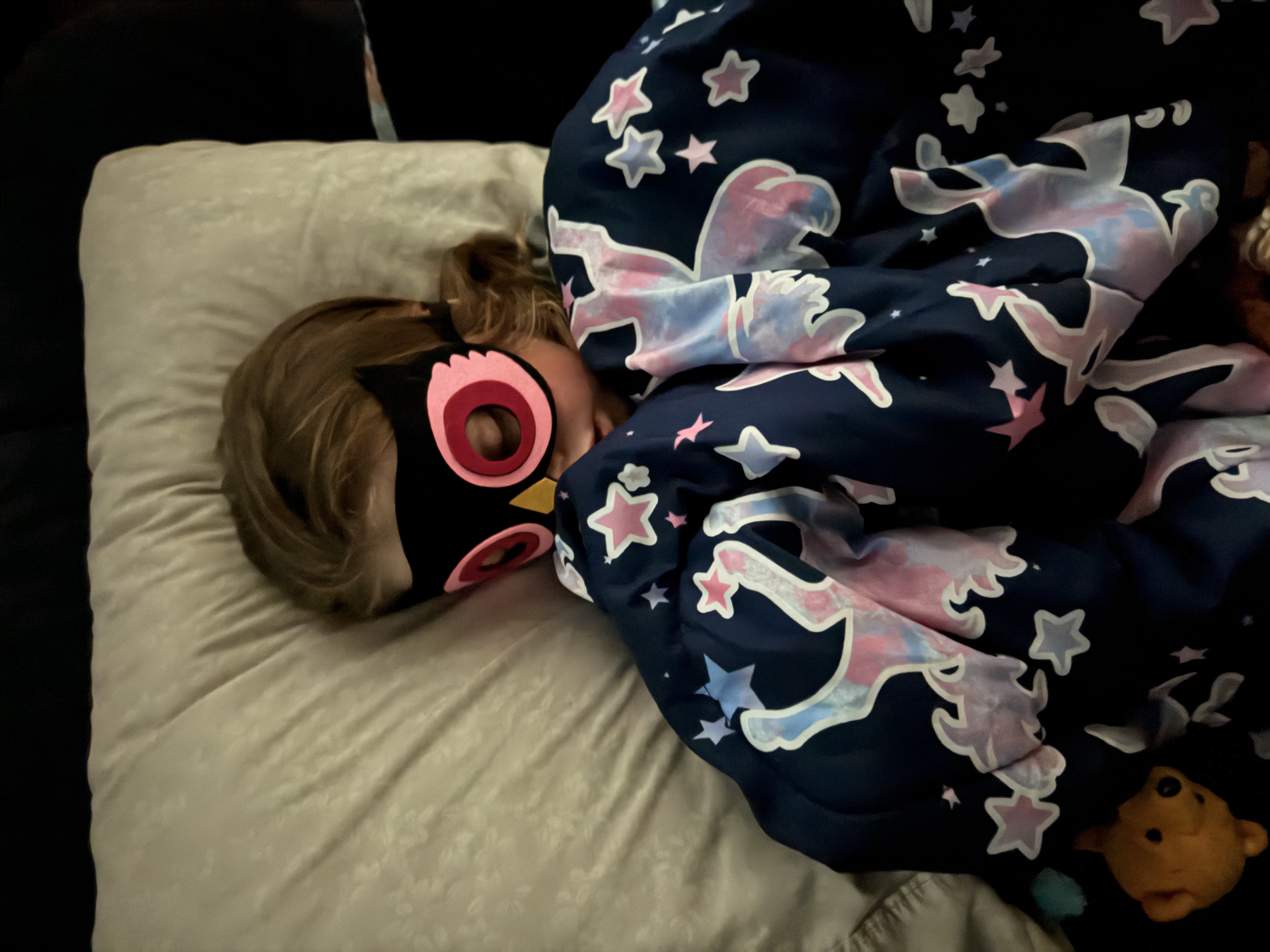
(my kid is officially in sleep mask mode)
Sleep, Mental Health, Substance Use
(I originally wrote this article for the Alaska Sleep Clinic's Sleep Education Blog and have modified my own for my newsletter. What an honor to partner with Alaska Sleep Clinic! You can read the original article here: https://www.alaskasleep.com/the-workplace-impact-of-sleep-deprivation-mental-health-struggles-and-substance-abuse/)
Sleep, mental health, and substance use are deeply interdependent: sleep disruption can increase vulnerability to substance use and mental health challenges, while substance use can further impair sleep and emotional regulation. One of the most important things any of us can do as individuals is prioritize sleep. One of the biggest power moves a company can make for its bottom line is to protect sleep and recovery at the systems level: through policies, staffing, scheduling, benefits, culture, and work design.
If you’re thinking, listen lady, I can’t control what my staff does after work regarding sleep, mental health, and substances. Keep reading! You may have more influence than you think, and there are some very clear benefits for integrating wellness solutions into your workplace culture, policies & benefits, and work design.
Fatigue, mental health, and substance use are not three separate issues living in three separate departments. They can show up together in absenteeism, presenteeism, turnover, safety incidents, healthcare costs, conflict, and performance problems. If we only address them through one-off programs, we miss the systems that may be producing or amplifying the risk.
The Cost
The National Safety Council (NSC) in partnership with NORC at the University of Chicago has published a Substance Use Calculator where you can choose your company size, industry, and state to see an average cost of substance use in the workforce. Here’s the link if you want to take a look: https://www.nsc.org/forms/substance-use-employer-calculator?srsltid=AfmBOorLhpes7nsqViSLsLDyJIKBhG-67cyM614rT6yq0bMG-geG_OCj
NSC and NORC have also developed a Mental Health Cost Calculator: https://www.nsc.org/workplace/safety-topics/employee-mental-health/cost-calculator?srsltid=AfmBOoqmtcUrnJpvMLsJPtZMlJRK69xgnvXIWj4xXUQqbGM5GCNx_BP-#/
Nationally, substance use disorder costs U.S. businesses upward of $81 billion per year in lost productivity and absenteeism, with direct medical costs estimated at about $35.3 billion annually. https://pmc.ncbi.nlm.nih.gov/articles/PMC9972180/
Fatigue is an impairment risk that affects attention, reaction time, judgment, communication, and decision-making. Think about the last time you have had a long stretch of low quality or quanitity sleep. How did it affect you? Did you forget things more easily, have a hard time focusing, notice you are more irritable or emotional?
The cost does not stop at health or workers comp claims. It shows up in absenteeism, presenteeism, turnover, safety incidents, conflict, reduced productivity, and leadership time spent managing preventable issues. Presenteeism (when someone is physically at work but too mentally, emotionally, or physically unwell to function at their best) is especially easy to miss because the person is technically “there.”
The Workplace Solutions
There is no one-size-fits-all solution for any of the issues we’re discussing, or we wouldn’t have anything to talk about! I encourage a more holistic approach to reviewing your own systems and engaging your workforce to understand issues, prioritize, and co-create solutions. But in the spirit of starting somewhere, here are some quick-fire, general recommendations to consider for the health of your workforce:
Benefits & Resource Access
Ensure your benefits include substance use, mental health, and sleep. Share that specific information with your workforce and use it yourself! (your health insurance benefits, EAP, local resources, along with crisis resources like 988, 211, findtreatment.gov)
Education & Awareness
Provide health education on substance use, mental health, sleep, fatigue, nutrition, movement, and recovery. Just remember: training is only the beginning. Knowledge is only power when it is put into action and when you keep pulling the string of awareness to find some root causes of the issues.
Work Design & Fatigue
Review work design & policies that impact workplace fatigue, and sleep.
-
Are there limits on shift duration?
-
Are breaks and meals protected in practice?
-
Is there recovery time after intense physical, cognitive, or emotional load?
-
Is there recovery time when shifts change from day to night?
-
Do employees have access to PTO, and are they actually using it?
-
Are staffing and workload expectations realistic?
- Are there limits on after hours communication and on-call protocols?
Culture
-
Review workplace practices that encourage overwork or create barriers to reporting fatigue, including attendance bonuses, glorifying visibility over outcomes, after-hours communication, and fear of consequences.
-
Consider reviewing ISO 45003, Consider reviewing ISO 45003, Occupational health and safety management — Psychological health and safety at work — Guidelines for managing psychosocial risks to see where your team lands in terms of psychological health and safety.
-
Consider implementing Recovery Ready and Recovery Friendly Workplace Practices.
While you may not be able to control what people do outside of work, you certainly have an influence, and you have a lot to gain from your workforce being well. If you’re looking at this list feeling overwhelmed, take a deep breath and consider asking this one question at your next leadership meeting and start removing the points of friction:
“Where are we making recovery (physical, cognitive fatigue & addiction), help-seeking, and reporting harder than it needs to be?”
You may not be able to control what people do outside of work, but you influence some of the conditions they are recovering from. You don’t need another one-off wellness initiative. You can start by looking at the systems you already have: schedules, staffing, workload, breaks, benefits, communication norms, leave practices, and recovery support, and making micro-adjustments.
When those systems are designed well, employees are more likely to sleep, recover, ask for help earlier, and do their best work. That is strategy, and reducing your reliance on individual resilience.
If you’re looking for a facilitated leadership discussion or fractional support to integrate workforce wellbeing throughout your organization and continue moving upstream of these issues, Integrating Wellness Solutions is ready to support. If you have personally attempted lifestyle changes and it's not budging your sleep, find help! Whether that is your primary care provider, or a Sleep Clinic, don't give up. Sleep is so critical to our overarching wellbeing!
Click to Schedule a Call with Me

Coaching Corner
What are your barriers for getting quality sleep right now? (think screentime, caffeine, alcohol use, monkey mind, environment, small kids, hormones, apnea, work schedule or conditions...)
How does having low quality or quantity sleep impact you? (think emotional regulation, energy levels, clear thinking, mood...)
What do you want to change to support your sleep? (think consistent wake time, no screens one hour before bed, no screens one hour after waking, environmental changes in the room- lighting, temp, sound, schedule that appointment to address hormones, apnea, etc....)
Sleep is like a secret weapon for our wellbeing, our recovery capital, and our leadership capacity! I know we all like to jump Maslow's Hierarchy of Needs up to Self-Actualization, but if you aren't sleeping, you aren't enlightening any time soon! Our phsyiological needs are so critical if we want to level up.
Upcoming Events
September: Leading Well: A 90-Day Fall Capacity Reset for People Leaders (Waitlist Opening in July. Stay Tuned!)
September: 90 Days Alcohol-Free Challenge Group (Waitlist Opening in July. Stay Tuned!)
October: Total Worker Health - Advancing Wellbeing in the Workplace through UW. I have been guest-lecturing for this course for two years, and Dr. Katia Costa-Black does an incredible job of keeping this course relevant for leaders working in industry now. If you are in HR, Safety, Workplace Wellness, Operations: this course is for you.
Ways to Work With Me Now
Click to Check out my Services
I have one opening for private coaching in July and space for one more workplace wellbeing consult until August! Don't hesitate if you've been thinking about reaching out. You can always schedule a zero pressure call with me if you aren't really sure what you or your organization needs.
Naomi DuCharme | [email protected]
Workforce Wellbeing Strategist, Facilitor, Coach
Integrating Wellness Solutions: Where safety, health, and wellbeing aren't one-off programs or initiatives; they're outcomes of well-designed, integrated systems.

Responses