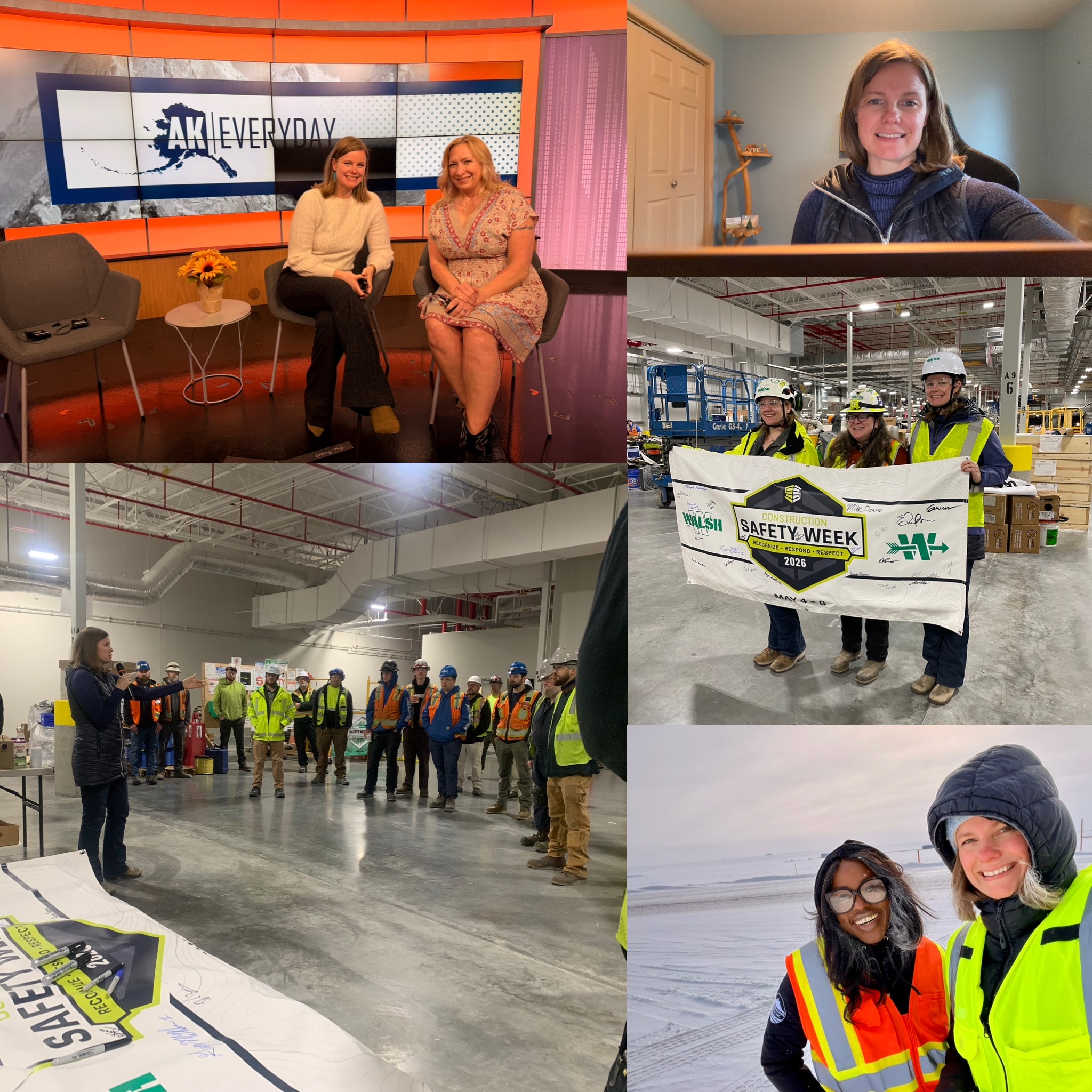
From Deadhorse to a whirlwind of Construction Safety Week to another Total Worker Health Cohort at University of Washington, to a Women's Sobriety Group, to the edge of my comfort zone filming a news piece with the Alaska Sleep Clinic on the connection between Sleep, Mental Health, and what the heck work has to do with it...and so much life between. Making every day count!
Mental Health Awareness Month & Substance Use at Work
When it comes to substance use and mental health, are you in awareness and gathering information phase, or action phase?
May is Mental Health Awareness Month and April was Alcohol Awareness Month. These are the perfect opportunities to start a conversation at work, at home, and/or reflect yourself about substance use and mental health:
-
Where are you or your organization at now?
-
Where do you want to go?
-
How will you get there?
In the circles I run, we are past the awareness level phase. I am witnessing too many organizations and individuals gets paralysis by analysis after awareness has been raised and inspiration has been sparked. If you do nothing after that inspiration is sparked, eventually other things take precedence and the spark fades.
These awareness campaigns are REALLY important. The free, accessible resources are helping spread the word far and wide, so if you are not taking full advantage of these opportunities, I hope you will make a plan to do so even if it's not during the month it falls.
However, if you're ready to move beyond just awareness and you don't know where to start, you are not alone and I am using my newsletter this month to:
1- Give you some free resources
2- Give you some guidance on layers of paid support
Before we get started on solutions, let's talk about the problems to help lay the foundation for why we should even be talking about this, let alone reading a 10 minute article when your attention span in mere seconds.
Sources: Ozluk P, CobbR, Sylwstrzak G, Raina D, Bailly E. Alcohol-Attributable Medical Costs in Commercially Insured and Medicaid Populations. AJPM Focus. 2022 Sep 24; 1(2):10036. doi: 10.1016/j.focus.2022.10036. PMID: 37791236; PMCID: PMC10546560
If you want a starting point to look at average cost of substance use in your industry, check out the National Safety Council in partnership with NORC, Employer Cost Substance Use Calculator
This tool provides business leaders with specific information about the cost of substance use (including prescription drug use and misuse, alcohol use and misuse, opioid and heroin addiction, as well as use of other illicit drugs and cannabis) in their workplace based on size of employee base, industry and state. Some other data sources to find within your own organization is at your health insurance claims data, your workers comp data if you categorize substance use impacted incidents, and if applicable in safety sensitive positions, your drug and alcohol testing data. (There's not a direct correlation, but it's also interesting to understand unplanned absenteeism rates and turnover data.)
The less-tapped data is your own people's perception of substance use's impact on safety and performance in the workplace. So far, I have been blown away at the perception of people that perceive substance use is playing a role in their workplace safety, health, and wellbeing. (when I get at least 100 responses from the North Slope and 100 from Construction off-slope, I will publish my findings here, but I think everyone would be surprised by the percentage of participants that state they are unsatisfied with their relationship with substances, and the percentage of participants that believe substances impact their workplace safety frequently or often as opposed to rarely and never.
Whether you use national data, state or regional data, or your own workforce's data, you might be surprised at just how much substance use is impacting your workforce, and you might consider re-prioritize the importance of addressing this topic in an evidence-informed approach. (Resist the urge to double your searches and drug & alcohol testing. If that worked, we wouldn't be talking about this right now)
Next let's take a look at Mental Illness, Mental Health Challenges, and Mental Health in the workplace (if you didn't know those three things are different, that's an opportunity to learn!). Here are some quick facts:
-
1 in 5 people in the US have a mental illness
-
Depression and anxiety cost the global economy about $1 trillion a year in lost productivity and account for 12 billion lost working days annually. (https://www.who.int/news-room/fact-sheets/detail/mental-health-at-work)
-
A WHO-led study found every $1 invested in scaling treatment for depression and anxiety returns $4 in better health and ability to work. (https://www.who.int/news/item/13-04-2016-investing-in-treatment-for-depression-and-anxiety-leads-to-fourfold-return)
-
In a 2026 NAMI/Ipsos poll, 53% of full-time employees said they felt burned out because of their job; 35% said their productivity suffered because of their mental health; 26% considered quitting because of work’s impact on their mental health. (https://www.nami.org/research/publications-reports/survey-reports/2026-nami-ipsos-workplace-mental-health-poll/)
NSC also has a Mental Health Cost Calculator: https://www.nsc.org/workplace/safety-topics/employee-mental-health/cost-calculator?srsltid=AfmBOop1-TAGszVo0rUdsXckW2sVEkZK1gdFo1FugmaPkVRji-LDd28h#/
The point of this data dump is to be clear, yes, I care a lot about people and want you to care too, but to deny that substance use & mental health is an operational priority with direct and indirect costs tied to it is... laughable. The opportunity here is BIG to make your workplace the conduit for warm connection to care, to manage risk in a more holistic way, to control hazards that maybe inadvertantly push people into crisis or create barriers for help-seeking, and promoting health education so your workforce can do their best work and live their best lives!
If you and your team are looking for solutions:
Here are some free resources to inspire you and your team to move toward action:
If you want to learn how me and my team of boutique contractors can support you, click below for a list of services:
 |
Self-Reflection Time

I am a systems thinker through and through, and there are systems that need to change for everyone to have equitable access to wellbeing at work, in the community, and at home but I am also well aware that we can't wait for systems to change to get our own wellbeing in check.
If you are receiving this newsletter, if you're in this communnity; you are a powerhouse! A force to be reckoned with!
I identify as a powerhouse too, and I almost let that identity bring me down. Too many of our systems rely on pressure being held by one or a handful of people. Pair that system with some high-achievers that haven't learned the art and science of recovery and engineering systems to support wellbeing, and you have a recipe for a period of high-performance followed by zombie-like stairs and disengagment, maybe a dose of cynicism, and physical illness the second you slow down. (Anyone else always get sick the second you go on vacation?)
This month, Mental Health Awareness Month, should also be a call for each of us to check-in with ourselves. Are we taking care or seeking support for signs of mental illness or mental health challenges? Support can look like scheduling some hangout time with someone you trust to chat with, or it might look like speaking to a professional, like a psychiatrist, or therapist. Or maybe you're just feeling stuck and could use the support of a coach to help you with gaining some clarity for forward motion.
This month is the perfect reason to do some quick self-reflection. How are you? No, really. How are you?
Do YOU have the support you need, or is it time to reach out to that friend or to a professional?
STOP PUTTING IT OFF! This is your month. Taking action now, could relieve a bit of pressure before summer really sets in. (I know it feels far off yet in Alaska, but it's coming!)
If you're feeling good and like you have the support you need, now is the perfect time to think about how you are cultivating mental health, and really overarching wellbeing in your life. Are you getting the basics?
-
Sleep
-
Movement
-
Nutritious foods & hydration
-
Connection with humans
-
Are you satisfied with your relationship with the common sources of addiction: Alcohol, Cannabis, Prescription, Illicit, or Recreational Drugs, Screens, Sugar
What about some bonus cultivators? Can you get:
-
20 minutes in nature
-
10 minutes of stillness or meditation (no input or output)
-
2 hours or less of non-productive screentime
-
No screentime within one hour of waking
-
No screentime within one hour of sleeping
-
-
Gratitude (write down 3-5 things you're grateful for)
-
Reading/Learning (sans screen)
-
Reflection/Journaling
-
Doing something for fun, not for producing or checking a box, but for JOY!
Are you crushing it right now, or is there an opportunity to take on one of these micro-actions to support your wellbeing? Don't fall into the trap to thinking you need to buy another gadget or start some new hack. One day at a time, these little micro-habits will change your life. They have changed mine and given me a much greater baseline of wellbeing than when I was waiting for those high intensity, one-off pushes to magically change my life.
Once you've done your reflection, consider bringing this topic up in your house and intentionally check-in with eachother. In our house, we do a "High-Low-High" around the dinner table: what was a highlight of the day, a low point, and end on another high point. My five year old is REALLY good at telling new people at our table how this works and she's getting maybe too good at her follow up questions after each share 😊
There's the quick and simple check-ins like the High- Low-High, and there's the bigger discussions about mental health challenges and mental illness and what resources are available. These are not simple things to discuss with your partner and your kids in an age-appropriate way, and your friends, but it is critical that we normalize the discussion and the many avenues to change. Get awkward! (I mean, get informed before you get awkward, but know that growth for you and everyone around you is right between that line of discomfort and safety!)
Here are some free resources to support your conversations:
Also, check your health insurance and if your employer has an Employee Assistance Program (EAP) for further resources, they often will cover your family members as well.
May is our time to check in, and create a plan so we can fully immerse ourselves in summer. It's right around the corner!
If you are not in need of clinical support but are seeking coaching support to either gain clarity or create an action plan for your own wellbeing, I take four 1:1 clients per month and I have one opening in June, and two left in July!
I also offer group coaching in the Spring and in the Fall. We are wrapping up our Spring Habit Reset, and I have started a waiting list for our Fall Cohort if you are interested in committing to micro-change that creates macro results with the support and accountability of a group and guided by yours truly. We will start in September, you can get on the waiting list now!
You don't want to miss this group. Our Spring Habit Reset Group is having some incredible results and we still have 3 more weeks to go! Everyone committed to reducing or stopping one behavior of their choice (alcohol, cannabis, tobacco, scrolling, online shopping, negative self-talk, busyness/overwork) and they integrated their choice from a menu of micro-actions to be consistently taken every day during the reset to support their wellbeing.
We are in week seven and the stark difference from week one is wild! Some true transformations have begun and it's an honor to guide and witness people that were prepared to quit the first week saying things like, "I feel so good I'm never going back." Or "This is the best sleep I have had in four decades...literally! Oh, and I exercise now, it is like, who I am now. Who knew?!" Or "If I treated my daily essentials and daily wins like a prescription pill, I could keep feeling this good." And my favorite, "I'm so much more patient with my kids and productive at work."
These are busy leaders in their workplaces, in their homes, in their communities and the absolute joy of my life is watching thier personal growth, but also picturing how these nine weeks of dedication to themselves might ripple out to their families, their coworkers, their friends, and their communities. It's a lofty idea, but that's the power of tending to your own garden: you can feed others!
No matter where you are on your journey, you are NOT alone. We are all at different places and there is no shame in being in the absolute pits, and there's no glory in setting up camp before you feel fulfilled and purpose-filled (No shade on resting, but don't set up camp. There's a difference).
I am with you in the pursuit of not just looking alive, but BEING alive!
Naomi DuCharme | [email protected]
Workforce Wellbeing Strategist, Facilitor, Coach
Integrating Wellness Solutions: Where safety, health, and wellbeing aren't one-off programs or initiatives; they're outcomes of well-designed, integrated systems.
© 2026 Integrating Wellness Solutions
Becoming Engines of Wellbeing™

Responses